
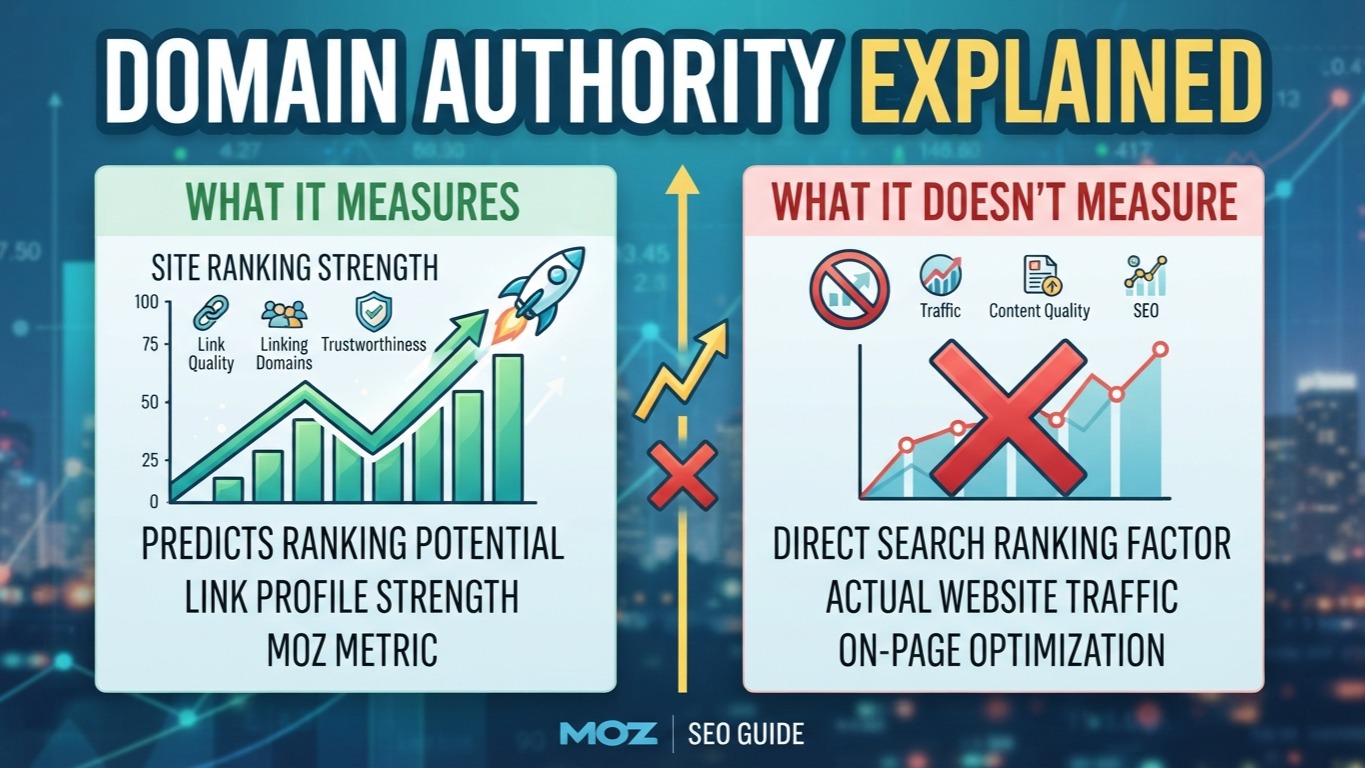
If you've spent any time researching SEO, you've run into Domain Authority (DA) — a score from 1 to 100 that's become shorthand for "how strong is this website." It shows up in outreach pitches, guest post negotiations, and competitor research across the industry. But it's also one of the most misunderstood numbers in SEO.
What DA is actually measuring
Domain Authority, developed by Moz, predicts how likely a website is to rank in search results — relative to other websites. It's built almost entirely from your link profile: how many domains link to you, and how authoritative those linking domains are themselves. A handful of links from genuinely respected sites will move your DA more than hundreds of links from low-quality directories.
The scale is logarithmic, not linear. Going from 15 to 25 is a realistic goal over a few months of solid link building. Going from 75 to 85 can take years, if it happens at all — you're competing with the biggest, most-linked-to sites on the internet at that range.
The mistake almost everyone makes
DA is not a Google ranking factor. Moz built it as an independent way to compare sites, and it correlates reasonably well with ranking ability — but Google has never used it, and never will, because it's not their metric. Treating DA as something to directly "optimize" is like optimizing your health for a fitness app's score instead of your actual health: the score usually moves in the right direction as you do the right things, but chasing the number itself is backwards.
Where DA is genuinely useful: comparing your site to competitors at a glance, tracking whether your link-building efforts are working over months (not days), and quickly sanity-checking a site before agreeing to a guest post or link exchange.
Checking your own score
You don't need a paid Moz subscription just to spot-check a URL. Our Domain Authority & Page Authority Checker pulls the live score directly from Moz's API — same numbers you'd see in their own dashboard, no account required on your end.
The takeaway
- DA measures relative link strength, not Google's opinion of your site.
- Small movements at low DA are normal; small movements at high DA take a long time.
- Use it to track trends and compare competitors — not as a target to chase for its own sake.